
LearnerDrive
LearnerDriveWhere Driving Improves
Driving Technique ยท Observation

When to check
blind spots

Mirrors show you most of what is behind you โ€” but not all of it. Here is exactly where your blind spots are, when an over-the-shoulder check is required on test, and when it is not.

Quick answer A blind spot check is required when moving off from a parked position, changing lanes, and in some junction situations. It is a shoulder glance โ€” not a full turn โ€” and skipping it when traffic is present will fail your test.
2
Main blind spots in every standard car
#5
Move off safely โ€” top 10 serious fault category
3
Key situations where a check is always required
1s
A proper blind spot glance takes about one second

01Where are your blind spots?

Your mirrors, when correctly set, give you a wide view behind and to either side โ€” but there are two zones they cannot reach. These sit diagonally behind each shoulder, between the coverage of your door mirrors and what you can see directly ahead.
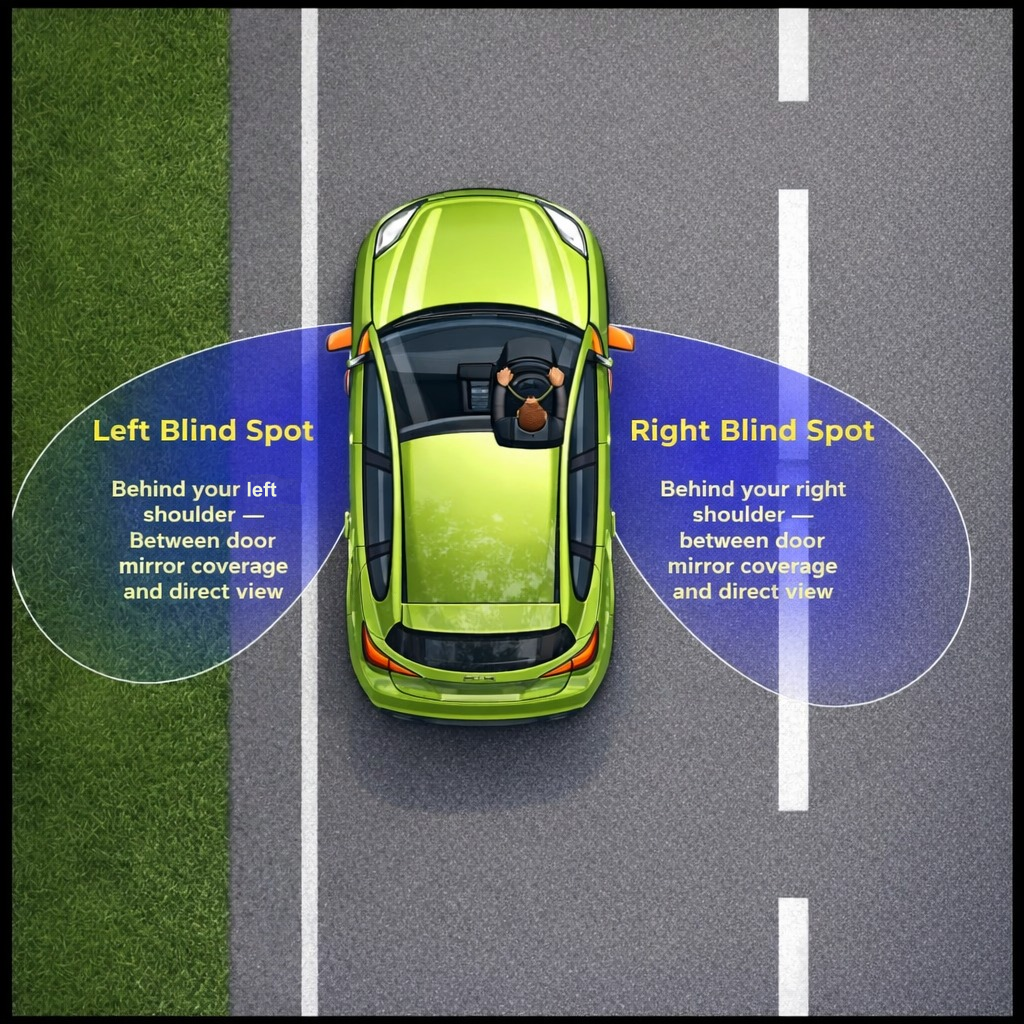
View from above โ€” driver's eye coverage
Diagram showing left and right blind spots either side of a car, viewed from above

The size of each blind spot depends on the vehicle. In a standard hatchback they are large enough to hide a motorcycle or bicycle entirely.

The A-pillar blind spot โ€” often forgotten

There is a third blind spot that learners rarely hear about: the A-pillar. These are the pillars on either side of your windscreen. At junctions, they can completely obscure a pedestrian, cyclist or motorcycle. Leaning slightly forward as you approach brings more of the junction into view past the pillar.

02When a blind spot check is required

The DVSA does not require a blind spot check at every conceivable moment. It requires one in specific situations where mirrors alone are not sufficient to confirm safety.

โœ“
Moving off from the side of the road Fail if missed with traffic present
Before pulling away from a parked position, check over the right shoulder. Mirrors are checked first as part of MSM, but the blind spot check is an additional over-the-shoulder glance just before you move.
โœ“
Changing lanes on a dual carriageway Serious fault risk
Before moving from one lane to another, check the mirror first, then glance over the shoulder in the direction you are moving. A vehicle can sit in your blind spot for several seconds โ€” particularly motorcycles.
โœ“
After an emergency stop โ€” before moving off again
Following an emergency stop, you must carry out full all-round observation before moving โ€” including both blind spots. A cyclist or motorcyclist may have passed while you were stopped.
โœ“
The pull-up-on-the-right โ€” reversing away
When completing the pull-up-on-the-right exercise and reversing back, full all-round observation is required, including blind spot checks over both shoulders before and during the reverse.
โ€“
Moving off in slow-moving queued traffic
If you are moving forward in a queue of traffic, an over-the-shoulder glance is not expected. Check all three mirrors, but a blind spot check in stationary queue traffic is not a test requirement.
โ€“
Normal turns at junctions Mirrors instead
Turning left or right at a junction does not require an over-the-shoulder blind spot check โ€” it requires proper use of mirrors as part of MSM. The two checks are different things.

03How to do a blind spot check correctly

A blind spot check is a quick glance over the shoulder โ€” not a full head turn. The correct technique is brief, deliberate, and visible to the examiner. It should take around one second.

1
Check your interior mirror
Establish what is directly behind you and how close following traffic is. This is part of MSM and comes first.
2
Check the appropriate door mirror
Right mirror before moving right, left mirror before moving left. Look for vehicles approaching from behind.
3
Glance over the appropriate shoulder
Turn your head briefly to look into the blind spot zone diagonally behind the shoulder on the side you are moving towards. About one second.
4
Move, if it is safe to do so
If the blind spot is clear, proceed. The check happens immediately before you move โ€” not several seconds earlier.
โœ“ Correct technique

A brief, deliberate turn of the head lasting about one second, immediately before moving. The examiner can clearly see your head move.

โœ— Common mistakes

A tiny eye-movement that does not cover the blind spot zone. Checking too early โ€” then moving several seconds later without rechecking.

โš  The timing fault

The most common blind spot error on test is doing it too early. Checking over your shoulder, then waiting ten seconds before moving without rechecking is not a valid blind spot check. The check must be immediately before you move.

04Left shoulder or right shoulder?

The direction of the check matches the direction of movement.

Which shoulder to check
The angle start โ€” most commonly failed

When moving off at an angle from behind a parked vehicle, some learners check the left shoulder by habit. The correct check is over the right shoulder โ€” because you are moving right into the traffic lane.

05Common questions

Do I need to check my blind spot when changing lanes at 60mph?

Yes. A well-practised blind spot glance takes about one second and has minimal effect on steering. Mirror first, signal, glance over the shoulder, then move. The glance is brief and deliberate.

What if I check my blind spot and there is something there?

Wait. This is exactly what the check is for. If a vehicle, cyclist or motorcycle is in your blind spot, you do not move. Wait for the space to clear, then recheck before moving.

Is a blind spot check the same as an MSM mirror check?

No โ€” they are different and both are required. The MSM mirror check uses your interior and door mirrors. The blind spot check is an additional over-the-shoulder glance. See the MSM guide for how the two fit together.

What about blind spots during reverse manoeuvres?

During bay parking, parallel parking, and the pull-up-on-the-right exercise, effective all-round observation is required throughout. See the parallel parking guide for the full observation sequence.

All LearnerDrive Guides